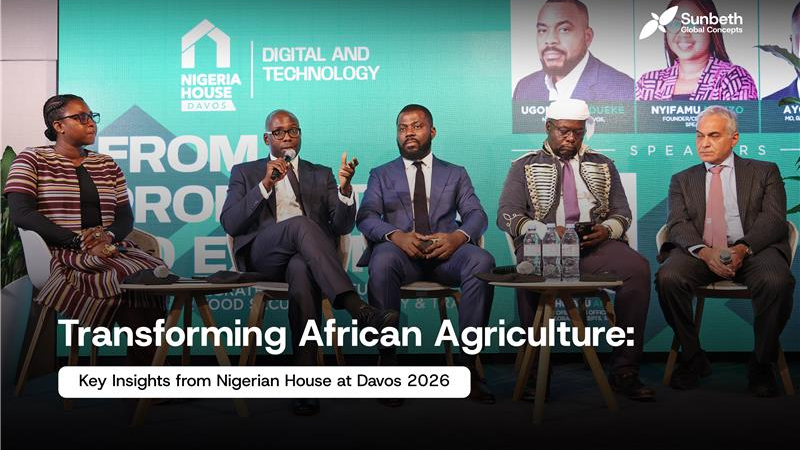
“A large percentage of funding mechanisms in Nigeria are tailored to favour trade finance. But if we intend to scale local processing, we must provide more patient capital to support infrastructure development.”
— Nzubechukwu Anisiobi at Davos
The above quote aptly captures the resounding insights from a panel discussion at the recently held Nigerian House launch at the World Economic Forum in Davos, Switzerland.
Between the 19th and 23rd of January, we joined a host of high-level stakeholders, and key business leaders, in advancing conversations around value-driven trade, local processing, and long-term collaboration across Africa’s supply chains.
Our Chief Operating Officer, Nzubechukwu Anisiobi, joined a distinguished panel where he spoke on the transformation of end-to-end agricultural systems across Africa. His insights focused on critical pathways for reducing losses, improving farmer income, and supporting agricultural industrialisation through strategic interventions in technology, infrastructure, financing, and standards.
The Processing Gap: Africa's Untapped Value
The panel addressed a pressing question: why does Africa continue to export the majority of its agricultural commodities in raw form, leaving value creation to foreign markets? Nzubechukwu highlighted this reality using cocoa as an example; approximately 75% of Africa's cocoa is exported raw, with only 25% processed on the continent.
“Exporting raw commodities is often the easy thing to do, but not necessarily the right thing to do.”
He explained, pointing to systemic constraints that perpetuate this pattern. The path to 2030 requires confronting these obstacles head-on, and he highlighted three pillars for achieving this.
1. Capital: Redesigning Financing Structures
Currently in Africa, the most significant barrier to local processing is the financing gap. Nzubechukwu noted that Nigeria’s financial ecosystem, like much of Africa’s, is heavily tilted toward trade finance, not industrial development. Commercial banks prioritise short-term, low-risk instruments, while large-scale processing requires patient capital; long-term funding that can absorb ramp-up periods and infrastructure costs.
At the same time, Development Finance Institutions (DFIs) often lack products that properly fit the realities of producers and processors along the value chain.
“There has to be an intentional effort from financial organisations and government to design funding structures that support large-scale processing operations,”
Without this fundamental shift in capital availability, the transition from commodity exporters to value-added processors would remain aspirational.
2. Infrastructure: Building the Foundation
Beyond financing, Nzubechukwu emphasised infrastructure as another critical pillar. He stated that,
“It’s impossible to develop processing facilities on a large scale on poor infrastructure.”
offering a direct assessment of the inadequacy of the current situation in Nigeria. Transformation requires significant upgrades to road networks, rail systems, power generation, and energy distribution.
Sunbeth’s view, as Nzubechukwu articulated, is that Africa must go beyond isolated projects and build industrial ecosystems such as parks and processing clusters. These setups attract investments, enable collaboration, and transform commodity processing from fragmented operations into integrated value chains.
Sunbeth Global Concepts is operationalising this approach with its industrial park, currently under development in Abeokuta, Ogun State. Designed to transform Nigeria's cocoa and cashew value chains, the facility will provide integrated processing infrastructure, reliable power, and logistics capabilities that make large-scale operations economically viable. It represents the kind of intentional infrastructure investment that can shift Nigeria from a raw commodity exporter to a major value-adding processor.
3. Pricing Power: Shifting the Balance
One of the most strategic insights from the panel highlighted Africa’s position as the “last mile” in global commodity pricing.
Because most commodities leave the continent raw, African producers rarely influence price formation. Instead, pricing mechanics are shaped by global players downstream, leaving local operators exposed to external manipulation and margin compression.
“We are the last mile and don’t get to influence pricing. That puts us at the mercy of global players,”
Nzubechukwu stated.
At Sunbeth, we believe that processing is not only about value addition; it also extends to negotiating power. When countries and companies process locally, they participate more meaningfully in price discovery, branding, and market positioning.
In simple terms: those who control processing control value.
Broader Solutions: Beyond Traditional Finance
The panel explored additional dimensions of the financing challenge. The CEO of the Nigerian Bank of Agriculture, Ayo Sotirin, also spoke on the need to modify financial products to better support agricultural growth, emphasizing that multiple structural issues must be addressed simultaneously — from access to improved seedlings to proper aggregation and distribution networks.
These are measures Sunbeth has been implementing with farmers across its sourcing networks over the years. However, these efforts must cascade across other influential players in the sector for an industry-wide transformation to occur.
Going further, the panel also explored emerging financial innovations. Speakers highlighted the importance of “financial mobility” which describes asset tokenization and converting physical assets into digital instruments that can unlock liquidity and borrowing power.
The Path Forward
Our participation at Davos was not just about contributing to a conversation; it reflects a strategic commitment to reshaping Africa’s commodity landscape.
The discussions made it clear that transforming African agriculture from subsistence into a sustainable, profitable, and value-adding enterprise requires coordinated action across multiple fronts.
As Nzubechukwu summarised during the session, the future of African agriculture depends on intentional collaboration between government, financiers, processors, and market operators to redesign the system end-to-end.
The expertise and understanding exist within Africa. What remains is marshalling the political will, financial resources, and collaborative spirit to turn agricultural potential into prosperity.