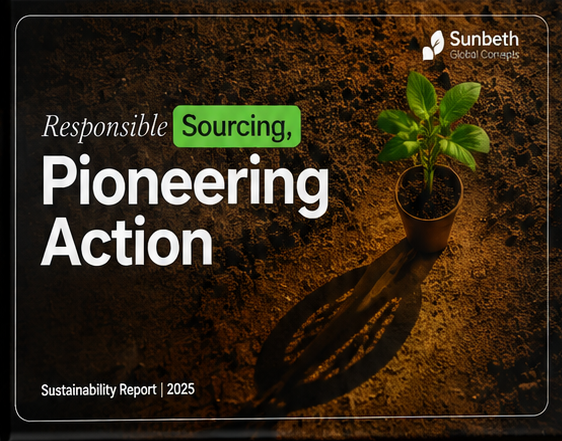
We have reached a defining milestone as a Nigerian agribusiness. With the launch of our inaugural Sustainability Report, “Responsible Sourcing, Pioneering Action,” we have become the first agricultural company in Nigeria, across the public and private sectors, to voluntarily align its sustainability disclosures with the IFRS S1 and S2 standards.
At Sunbeth Global Concepts (SGC), we see this achievement as more than a reporting first. It signals what is possible when a Nigerian agribusiness puts transparency, climate accountability, and responsible sourcing at the centre of its operations. Our inaugural 2025 Sustainability Report shows how these priorities shape the way we measure progress, manage risk, support farmers, and prepare our business for the future.
Why this historic milestone matters
Our IFRS alignment matters because agricultural businesses are increasingly judged not only by what they produce, but by how clearly they identify and manage the climate, social, and supply-chain risks behind that production. By reporting through a globally recognised framework, we can give investors and lenders decision-useful information, strengthen our readiness for evolving export requirements, and hold ourselves accountable for progress against measurable commitments. This is how stronger disclosure can translate into greater resilience for our business, more secure access to international markets, and better long-term outcomes for the farmers and communities connected to our supply chain.
IFRS S1 and IFRS S2 are international sustainability reporting standards issued by the International Sustainability Standards Board (ISSB). Together, they provide a global framework for companies to disclose sustainability-related risks and opportunities. Aligning with these standards in our first reporting cycle places our disclosures on a globally recognised footing and enables us to provide investors, capital providers, and international markets with the thorough, actionable sustainability and climate information expected of the world’s largest companies.
As our Managing Director, Olasunkanmi Owoyemi, explains: “Responsible sourcing is not a buzzword for us; it is fundamental to how we operate, manage risk, and create sustainable long-term value. Our adoption of IFRS S1 and S2 reflects our commitment to meeting global sustainability and disclosure standards because Nigerian agriculture deserves to compete at the highest level. While building the systems required for this transition has demanded significant investment, it is a necessary step to strengthen the resilience of our business and ensure we can continue supporting the thousands of farmers whose livelihoods depend on access to international markets.”
Turning disclosure into better decisions
For us, adopting the IFRS S1 and S2 standards means more than producing a report. It means integrating sustainability considerations into strategic decision-making, connecting climate and social data to financial performance, and showing investors and financiers how our business model is built for long-term resilience.
Our Sustainability Director, Oyinkansola Owoyemi, puts it this way: “This is about integration, not just disclosure. Adopting these standards forces us to demonstrate that responsible business practices are not at odds with commercial success; they are foundational to it. For a sector that sits at the intersection of climate risk, community livelihoods, and global supply chains, this level of accountability is overdue.”
At the report launch, our Sustainability Manager, Modupe Ojo, also explored the business case for sustainability during a fireside chat. Her message was clear: sustainability is not simply a compliance exercise. It is a practical way to manage costs, protect revenue, and maintain access to critical export markets.
Our progress in action
The report, “Responsible Sourcing, Pioneering Action, ”captures a year of measurable progress in ethical sourcing, community resilience, and traceability. We polygon-mapped more than 140,000 hectares and 30,000 farmers to support EUDR-ready traceability. Through our Child Labour Monitoring and Remediation Systems (CLMRS) programme, we remediated 80 child-labour-risk cases after becoming the first Nigerian company to join the International Cocoa Initiative (ICI). We also trained more than 6,000 farmers, distributed60,000 hybrid cocoa seedlings, and established a 292.81 tCO2e baseline for Scope 1 and 2 emissions, alongside a net-zero-by-2050 target.
In 2025, we exported more than 58,000 metric tonnes of cocoa, reinforcing our position as Nigeria’s leading non-oil exporter. The launch of this report marks a new chapter in that journey: one in which commercial leadership is matched by transparent, internationally comparable sustainability disclosure. We see it as both a record of our progress and a commitment to keep raising the standard for how agribusinesses source, measure, disclose, and create lasting value. You can read the full report here.
Looking ahead
Since our establishment in 2017, we have built strong roots in the cocoa industry while expanding our contribution across the broader agricultural value chain. Through strategic partnerships, innovation, and industry expertise, we remain focused on empowering farmers, driving socio-economic impact, and delivering sustainable growth and trusted solutions to partners worldwide.
.jpg)