What the price on the screen leaves out
It is 9 a.m. in London. The September cocoa contract ticks up, and somewhere a trader makes money without touching a single bean. At the same hour, in a warehouse in Nigeria, a quality-control executive draws a sample from a lot of cocoa and runs final checks to determine whether it is fit for export.
Both the trader and the cocoa-exporting company are in the cocoa business. They are linked by the same commodity and benchmark prices, but they do not carry the same costs, obligations or risks.
The futures market provides a standardised price and risk-management instrument linked to deliverable cocoa. The physical market turns beans into an exportable cargo. The distinction matters because the number on a screen is only the starting point for what an exporter can earn, and only a partial account of what can go wrong.
Paper Cocoa and Physical Cocoa
“Paper cocoa” is a futures contract: an agreement to buy or sell a specified quantity and grade at an agreed delivery point and date. Although a contract can end in delivery, many positions are closed beforehand. Traders can therefore gain or lose from price movements without taking possession of the beans.
That is not a flaw. Grinders use futures to manage input costs. Exporters and buyers use them to reduce exposure to price movements between contracting and shipment. Speculators add liquidity, helping commercial participants enter and exit hedges.
But the contract is an instrument, it is not subject to the same risks as the physical cocoa. Although it has potentially severe exposure risks, they are different from the operational burden of moving physical beans.
Physical cocoa begins on farms, many of them smallholdings, across West Africa. Farmers harvest the pods, ferment and sun-dry the beans, bag them and sell through local supply chains.
The beans move from buying centres to warehouses and onward to a port. Roads can deteriorate during the rainy season, trucks can break down and vessel schedules can change. Every extra day can add storage, handling and financing costs. A benchmark price may move in seconds; a physical cargo can take weeks or months to reach a buyer.
Where the Two Realities Split
The same word “cocoa” covers one commodity moving through two systems. A useful comparison begins with four differences.
Time. Futures trade in seconds. Physical cocoa takes weeks or months to move from farm to vessel, and each day can add cost or risk.
Money. A futures participant posts margin and manages financing in the currency of the contract. A Nigerian exporter may buy locally in naira, borrow in naira or dollars, sell against a London or New York benchmark and pay costs in several currencies. Interest can begin when money is advanced to a buying agent, not when the cargo sails.
Risk. A trader faces price, margin, liquidity and basis risk. An exporter faces those risks alongside rain, mould, theft, a rejected lot, a broken-down truck, a missed vessel, currency movements and changes in trade policy.
Quality. A futures contract specifies deliverable grades and locations. Physical cocoa must still be sampled, tested, documented and accepted lot by lot. The contract standard does not remove the work required to make a particular cargo compliant.
The Paperwork Physical Cocoa Carries
A futures contract identifies a commodity, quantity, grade, delivery location and date. A physical shipment must also answer where the beans came from, how they were handled, whether they meet food-safety rules and whether the proceeds are returned through the required financial channels.
Deforestation Due Diligence
Under the EU Deforestation Regulation, large and medium-sized operators placing cocoa products on the EU market are due to comply from 30 December 2026; qualifying micro and small enterprises generally have longer. The rules require due-diligence information, including geolocation data, to show that covered commodities were not produced on land deforested after 31 December 2020. Although the legal duty falls on regulated EU operators and traders, demand for plot-level data reaches exporters, buying agents and farmers.
Two bags of similar cocoa can consequently have different market access if only one can be traced to compliant source plots. Food-safety compliance creates a similar divide: cargo that exceeds a destination market’s limits for pesticide residues or other contaminants can be detained, discounted or rejected. (Ecofin Agency)
When Paper and Physical Collide
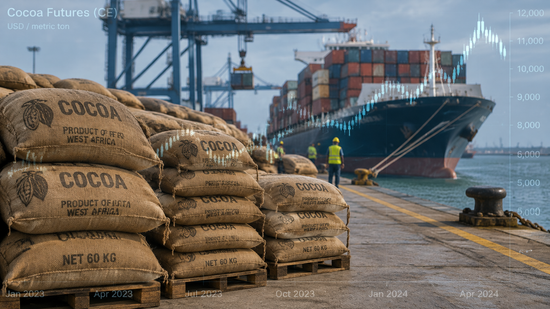
The 2024 price surge showed how the two systems can collide. Futures climbed above $10,000 a tonne, but that did not guarantee a windfall for exporters. Higher margin requirements made hedges more expensive, while exporters that had sold forward at lower prices still had to buy beans in a rising local market. A higher screen price could therefore create a cash crunch rather than an immediate gain.
The volatility continued into 2026. A reported cocoa price series fell to about $2,846 per tonne in March and later rose above $6,400 in July, more than doubling from the low. The exact move depends on the contract and series used, which is why any price comparison should identify the exchange, currency, contract month and observation dates.
Where the Two Markets Meet
To be fair, the two worlds do touch. When a futures contract runs to delivery, someone has to hand over real beans in a certified warehouse. And every physical sale an exporter makes is priced as the futures price plus or minus a differential: a premium or discount for origin, quality and terms.
That differential is where the physical world shows up in the price. It carries Nigeria's reputation for quality, its exporters' reliability on delivery, and now their ability to prove traceability. The screen price is where the conversation starts. Everything between that number and what the farmer receives is the exporter's world.
So, Is Paper Cocoa the Same as Physical Cocoa?
Paper and physical cocoa represent the same underlying commodity, but they are not economically identical. Futures concentrate standardised price exposure. Physical trade combines price exposure with quality, logistics, financing, currency and compliance risk.
Those additional risks do not disappear because the benchmark is rising. They are carried across the supply chain by farmers, buying agents, warehouse operators, exporters, processors and buyers, often with limited room for error. Traceability requirements add another layer of cost and market-access risk that may not be visible in a quoted futures price.
None of this diminishes the value of futures; it explains their limits. The futures price tells us what the market thinks standardised cocoa is worth. The physical supply chain reveals what it costs, and what can go wrong, to make that cocoa deliverable.