
We sat down with our Corporate Finance team to answer the questions that matter most to investors considering our ₦100 billion Commercial Paper Issuance.
What is the minimum investment amount, tenor, and expected yield?
The minimum subscription is ₦5,000,000, with investments in multiples of ₦1,000 thereafter. The CP is issued in three tranches with the following confirmed tenors and yields:
- 180 days at 21.00% per annum
- 270 days at 22.50% per annum
- 364 days at 23.50% per annum
The Commercial Papers will be quoted on FMDQ and/or NGX, ensuring a regulated and transparent investment environment.
How will the Commercial Paper be repaid?
Repayment will come entirely from our operating cash flows — specifically, export proceeds and receivables generated under binding offtake contracts with our international partners.
How does Sunbeth manage commodity price risk on behalf of investors?
We actively hedge price and volume exposure using ICE Futures contracts through our international brokers, StoneX and Macquarie. For every confirmed export sale, we place an equivalent short hedge position that is closed at shipment. Any gains or losses on the futures position are offset against the physical sale, effectively protecting our trading margin. This back-to-back structure means our earnings are not at the mercy of commodity price swings.
At ₦200 billion programme size, how does this compare with others in the Nigerian market?
While the programme size is large, it is in line with issuances by well-rated and established Nigerian corporates. The size reflects the scale of the Company’s operations and its working capital requirements, rather than an aggressive increase in leverage.
Why issue all three tranches concurrently rather than staggering them?
Cocoa export cycles are seasonal and volume-intensive. Issuing three tranches concurrently — at 180, 270, and 364 days — allows us to match funding tenors to specific transaction phases in our pipeline.
Is this a secure and well-governed investment?
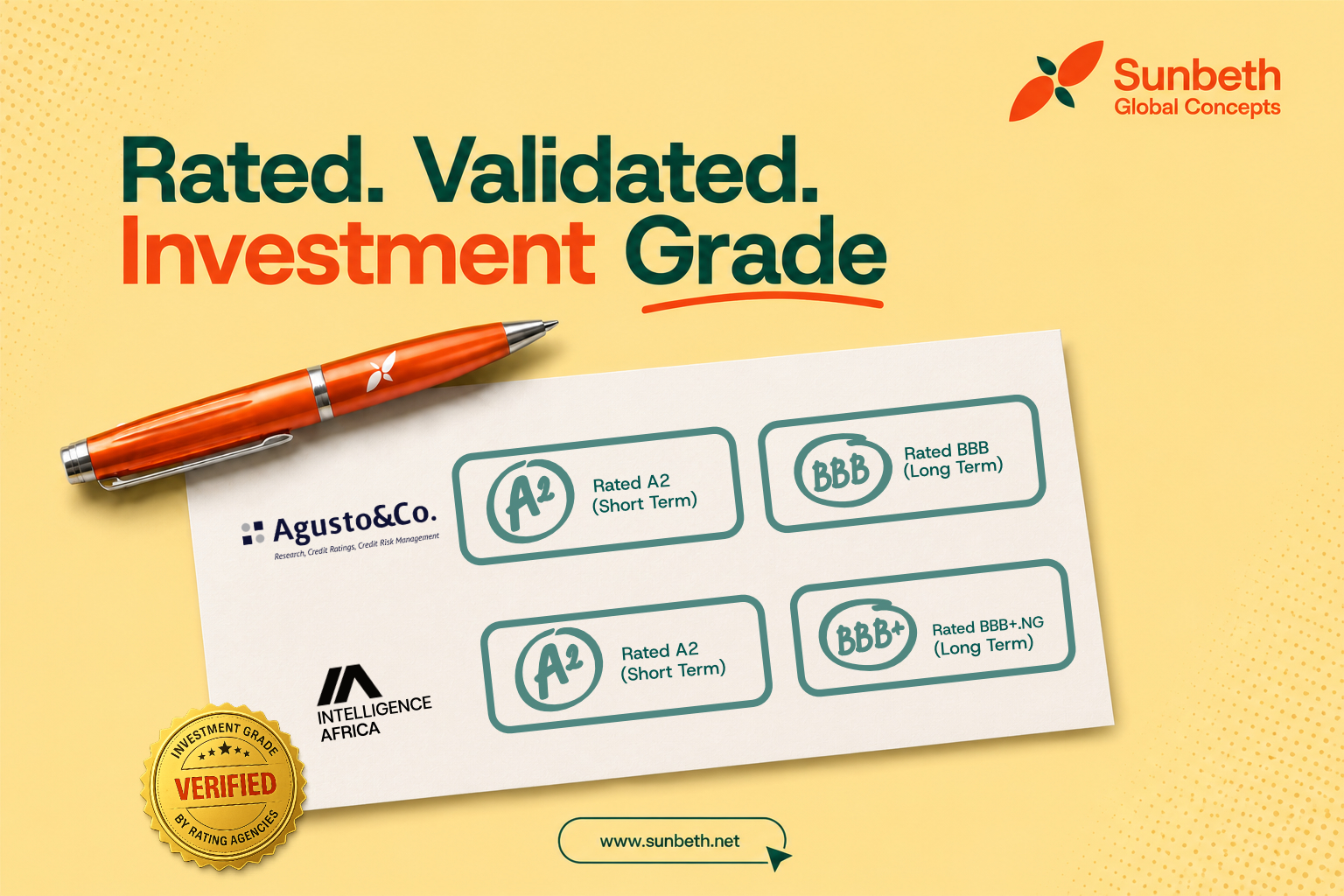
Yes. We’re currently rated A2 and A+ by GCR and DataPro respectively, placing us in line with the most credible CP issuers in the Nigerian market. These ratings are on a short-term horizon but we have BBB+ long term rating by GCR and an A+ long term rating by DataPro. We have a clean track record of servicing all short-term trade finance and bank facilities without default. There are no pending litigations, tax exposures, or contingent liabilities, and CP investors are not exposed to cross-default risks from any affiliate entities. Our governance framework, which underpins these ratings, is what gives the capital markets confidence in this issuance.
Get in touch
To invest or find out more, contact our Corporate Finance team at corporatefinanceteam@sunbeth.net. We are ready to guide you through the process.
.jpg)