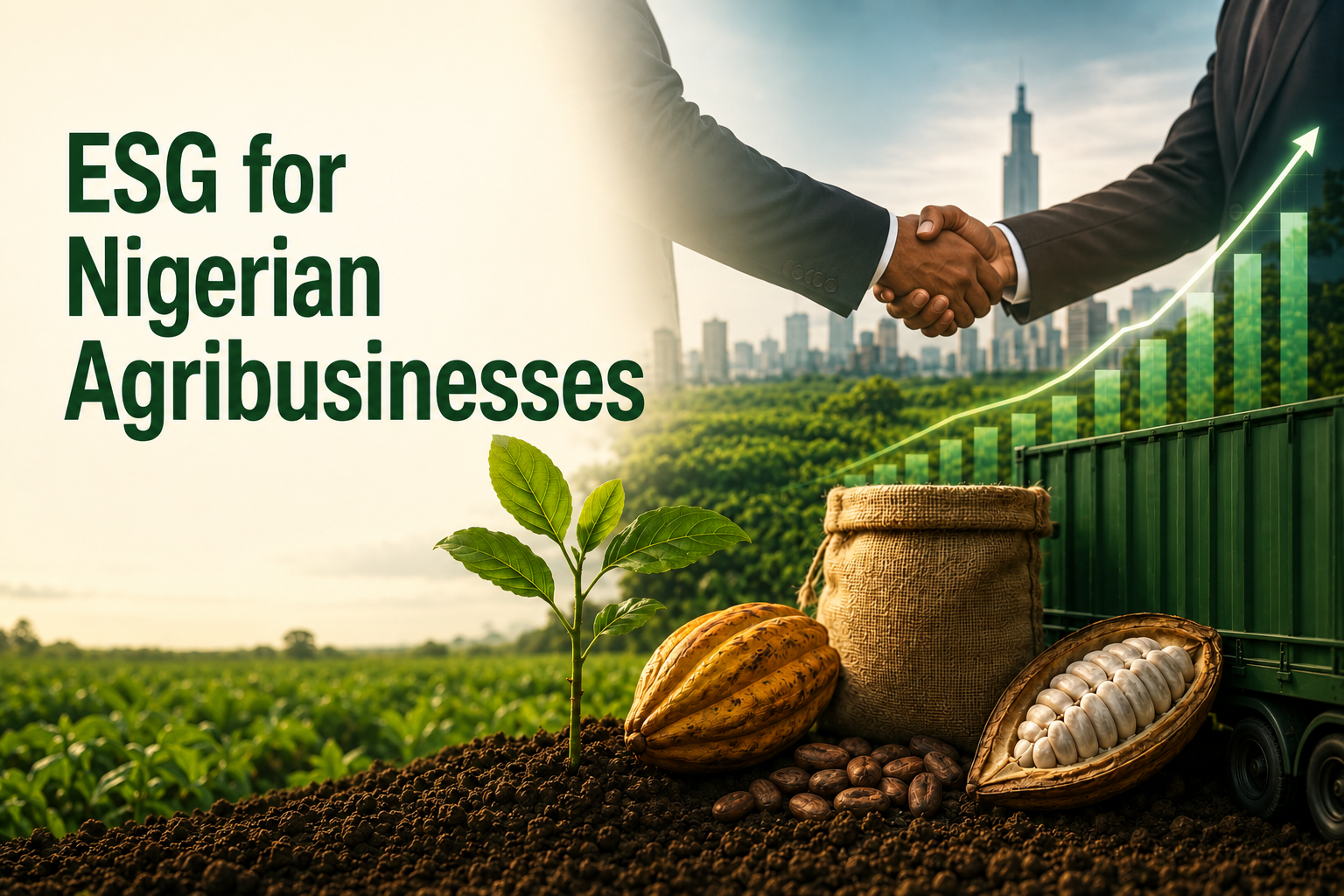
Somewhere in Nigeria, there is an agribusiness doing everything right, or at least everything that used to be right. Product quality is strong. Buyer relationships are solid. Operations are running. Yet in procurement departments across Europe and North America, decisions are being made quietly, and some Nigerian suppliers are not making the cut anymore.
Not because their product is inferior. Because they cannot tell the story of where it came from.
This is the compliance gap: the growing distance between what Nigerian agribusinesses currently document about their supply chains and what global markets now require them to prove. It is the most consequential and least discussed commercial risk facing the sector today.
When international buyers source cocoa, cashew, sesame, or other agro-commodities from West Africa today, they are not simply buying a product. They are buying a story they can verify: where it came from, how it was grown, whether the land was responsibly managed, whether farmers across the supply chain were treated fairly. That story is no longer a wish list. It is increasingly a procurement checklist.
The European Union Deforestation Regulation, now shaping the terms of market access, requires full traceability to production plots. Sustainability compliance, documented climate-smart practices, and verifiable ESG alignment are becoming standard entry conditions for premium export markets. Not differentiators that win contracts. Baseline conditions without which contracts are lost.
The businesses that have built these systems are quietly strengthening their position. Those that have not are losing ground, often without fully understanding why.
Part of what makes this gap so costly is timing. Building traceability infrastructure, training farmers in documented practices, and maintaining sustainability data takes real investment of time, money, and organisational focus. For businesses managing the daily pressures of volatile prices and difficult logistics, compliance work is easy to deprioritise. But by the time the gap becomes visible, a contract not renewed, a buyer who stops responding, a shipment returned, the cost of catching up is already significantly higher than the cost of starting early would have been.
At Sunbeth, this work has been underway for years, not as a PR exercise but as operational infrastructure. We have GPS-mapped over 22,000 smallholder farmers across eight Nigerian states, trained more than 6,000 farmers in Ondo State in climate-smart agricultural practices, and built traceability systems that connect field-level data to our supply chain and satisfy international verification requirements. Our IMS framework now covers all six major certified farmer groups, and all non-conformities from prior audit cycles have been closed.
We share these figures not to position ourselves above the challenge, but because they represent proof of concept. This kind of compliance infrastructure is buildable. It takes commitment and consistency, but it is not out of reach, and for businesses that want to remain competitive in global markets over the next decade, it is not optional.
As our Sustainability Director Oyinkansola Owoyemi puts it: ESG must be operational, not performative. Credibility built on real data and field-level evidence is what earns and keeps the trust of global buyers. Everything else is branding, and buyers increasingly know the difference.
The gap is still closable. The agribusinesses that begin building now, investing in farmer mapping, traceability, and climate-resilient sourcing structures, are the ones who will be positioned when the next wave of market requirements arrives. And it will arrive.
Download the full Sunbeth Climate-Smart Agriculture whitepaper to understand what compliance-ready agribusiness looks like in practice here.
.jpg)